Home › Commercial Asphalt Resurfacing & Overlays
Refresh worn pavement with commercial asphalt resurfacing in Boise, ID. We repair structural failures, then install overlays that smooth rough parking lots and drive lanes. Our crew assesses the existing base, drainage, and traffic patterns to recommend the right resurfacing plan so your business gets a cost effective upgrade that looks new and performs reliably.
Precision Asphalt Boise provides professional commercial asphalt resurfacing throughout Boise, ID, ID and the surrounding area. Our licensed, insured crew delivers safe, clean, on-time work with a free estimate before anything begins. Call (208) 783-3122 or request your free quote.
Commercial Asphalt Resurfacing in Boise That Holds Up to Real Traffic
If your commercial parking lot or private roadway in Boise is cracked, rutted, or just plain worn out, you do not always have to tear it out and start from scratch. Commercial asphalt resurfacing, also called an asphalt overlay, lets Precision Asphalt Boise install a new, load‑bearing layer of asphalt over your existing pavement, provided the base is still structurally sound.
For retail centers, medical offices, industrial yards, and HOA streets around Boise and Meridian, resurfacing is usually the sweet spot between a quick patch job and an expensive full reconstruction. It improves drainage, ride quality, and curb appeal, and it can usually be done while your property stays partially open for business.
Resurfacing is not a shortcut. Done correctly, it starts with evaluating the existing pavement. We look for base failures, repeated potholes in the same spots, standing water after irrigation or storms, and how the surface handles heavier vehicles like delivery trucks or garbage collection. If the subgrade is failing in multiple areas, we will tell you up front that milling and patching or full reconstruction is the better option. If the issues are mostly in the upper few inches, a commercial asphalt overlay is usually the most cost‑effective fix.
How Precision Asphalt Boise Actually Performs an Overlay
Commercial asphalt resurfacing is a sequence of specific steps, not just “paving over what is there.” Precision Asphalt Boise follows a process tailored to Boise’s soils, freeze‑thaw cycles, and local traffic patterns.
1. Site inspection and core checks. We walk the lot or roadway, mark failed areas, and when needed take small cores to see asphalt thickness and base condition. This tells us if the pavement can support an overlay and how thick the new lift should be.
2. Structural repairs and patching. Areas with alligator cracking, pump‑up of fines, or repeated potholes are cut out and replaced with new base and asphalt. This is critical, because an overlay will mirror those failures in a few seasons if they are not corrected first.
3. Milling for transitions and drainage. Around concrete approaches, ADA ramps, drain inlets, and building entrances, we mill down the old asphalt so the new overlay ties in without creating trip edges. We also use milling to restore proper drainage to catch basins or valley gutters, which is important here given Boise’s spring runoff and irrigation overspray.
4. Cleaning and tack coat. The entire surface is swept clean with power brooms, then we apply a tack coat (a thin sprayed layer of asphalt emulsion) to bond the new overlay to the old pavement. Without a proper tack coat, layers can delaminate, leading to shoving and early cracking.
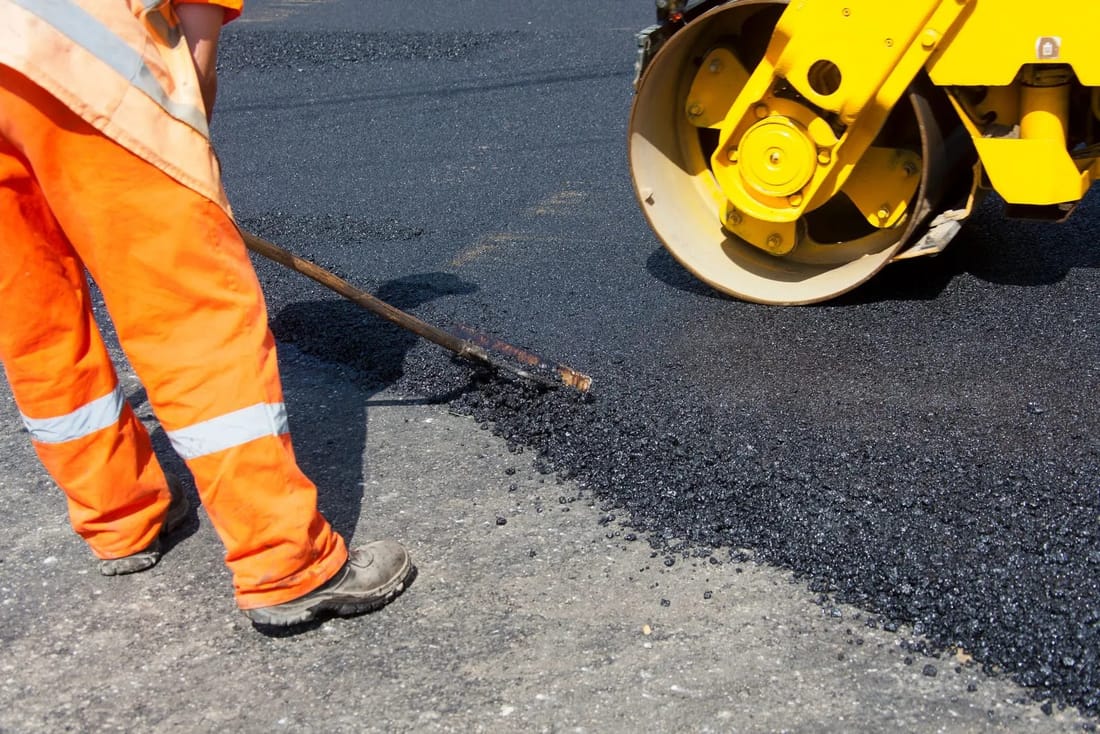
5. Placing the new asphalt overlay. For commercial work we typically install 1.5 to 2.5 inches of hot‑mix asphalt. Heavier truck areas, like loading docks along Franklin or Eagle Road, often need the thicker end of that range. Mix design is selected for Boise’s climate and your traffic loading, not just what is cheap that day.
6. Compaction and finishing. Our rollers compact the asphalt to the specified density, watching that we do not push the mix or create low spots. Joints are hand‑worked and rolled so you do not end up with seams that unravel in a few winters.
7. Striping and signage. Once the asphalt cools, we restripe stalls, fire lanes, ADA stalls, and crosswalks. If you are adjusting layout to meet current ADA or fire code, we coordinate that during planning so it is correct on day one.
Local Conditions, Permits, and What Boise Property Managers Should Know
Boise’s weather and local rules influence how commercial asphalt resurfacing should be planned and executed. Precision Asphalt Boise schedules overlay work during suitable temperature windows so the mix can be compacted properly, usually late spring through early fall. Trying to squeeze in resurfacing on a cold November morning is a good way to shorten the life of your new surface.
In the Boise area, private commercial lots generally do not require a full city street permit, but there are situations where coordination is needed. If your resurfacing affects an approach that ties into a public street, or if traffic control will impact a city roadway, you may need approval from the City of Boise or ACHD (Ada County Highway District). We routinely coordinate traffic control plans and work hours for sites along busier corridors like Fairview, Chinden, and State Street so your project does not create conflicts.
Many HOAs around Boise, Kuna, and Meridian have specific requirements about access, dust control, work hours, and emergency vehicle routing during resurfacing. For private streets and shared drives, we can meet with the HOA board or property manager, explain the schedule in plain terms, and help you communicate phased closures to residents.
Drainage is a major local concern. Sprinkler overspray and snow melt that sit on the surface will accelerate cracking and raveling. Before overlaying, we check for birdbaths and flat spots, then adjust slopes with milling and leveling courses where possible. On older lots with undersized or sunken drain inlets, we can reset frames or recommend cost‑effective fixes so your investment is not undermined by standing water.
Winter maintenance is another Boise‑specific issue. A newly resurfaced lot will handle plows, but the cutting edge should be adjusted and operators should avoid aggressive chains on bare asphalt. We can review your snow removal plan and give your contractor simple guidelines so the overlay is not scarred up in the first season.
Cost, Thickness Options, and What Drives Your Budget
Commercial asphalt resurfacing costs in Boise are driven by a handful of practical factors, not guesswork. Precision Asphalt Boise walks through these with you so you can decide what level of work matches your budget and how long you plan to own the property.
Key cost drivers include:
• Size and layout of the area. Large, open lots are more efficient than small, chopped‑up drive lanes with islands and tight turns. More handwork and trimming increases labor and time.
• Amount of milling and base repair. If we only need edge milling and a few isolated patches, costs stay moderate. If 20 percent of the lot has structural failure that needs dig‑outs and new base, costs rise but so does the life expectancy of the overlay.
• Overlay thickness and mix design. A 1.5‑inch overlay might be acceptable for light car traffic at an office complex, but a truck court serving delivery vehicles off I‑84 really needs 2 to 3 inches and a stronger mix. Thicker lifts and higher‑performance mixes add cost up front and reduce risk of rutting and early fatigue.
• Access and phasing. If we can pave a large section in one or two passes, costs are lower. If your operation requires multiple tight phases, night work, or complex traffic control to keep businesses open, plan on additional costs.
We usually present at least two resurfacing options. For example, an older retail center near the Boise Towne Square Mall might see one plan with heavier repairs and a thicker overlay for a 15‑year target life, and a leaner plan with minimal repair and a thinner overlay for a 7 to 10 year horizon. You get clear line items, not vague lump sums, so you can see where your money is going and what you gain by stepping up to a more robust solution.
How to Tell if Resurfacing Is Right for Your Property
Not every aging parking lot or private road in Boise is a good candidate for commercial asphalt resurfacing. Precision Asphalt Boise spends time on this decision before we propose anything, because forcing an overlay on a failing base is a waste of your budget.
Resurfacing may be the right choice if:
• Most of the pavement is intact but has surface cracking, raveling, or light rutting.
• Potholes are limited to a few areas that can be patched.
• The lot drains reasonably well, or drainage can be corrected with milling and leveling.
• You have not already overlaid the surface multiple times to the point that curb heights and thresholds are a problem.
You may need a more extensive rehab or reconstruction if:
• Large areas show deep alligator cracking that flexes under truck tires.
• There are chronic subgrade issues, such as pumping, settlement, or extensive heaving from Boise’s freeze‑thaw cycles.
• Water stands for long periods in multiple sections and cannot be corrected with modest slope adjustments.
We will walk the site with you, mark problem areas in paint, and explain, in plain language, what we would do if it were our property. If full reconstruction is the honest answer, we say so and explain why. If resurfacing is appropriate, we explain the expected life span, the maintenance it will need, and how to plan the work so it disrupts tenants and customers as little as possible.
When you are ready to look at commercial asphalt resurfacing for your Boise, ID property, Precision Asphalt Boise can provide a detailed plan and schedule, not just a one‑line quote. That way you know exactly what will be done, how long it will take, and what kind of service life you can reasonably expect from your investment.